
This summer I went to the Florida Keys with SCUBAnauts International. We stayed at Mote Marine Laboratory’s Keys facility, the Elizabeth Moore International Center for Coral Reef Research & Restoration (IC2R3). Our goal was to conduct research projects while SCUBA diving.
In our pre-trip planning meeting we were assigned science groups and started working on our research question. My group’s question was “if a mass heating event occurred would the fish diversity and abundance decrease?” A heating event is when the water reaches a certain temperature and corals bleach expelling an algae that helps them get food and gives them their color. The algae, Zooxanthellae, supply them with most of their food, without the algae they can starve.
Our hypothesis was that from 2021 to 2025 fish diversity and abundance would have decreased because of the mass heating event in 2023. The mass heating event killed a lot of coral so we thought that would have negatively affected the fish populations.
We studied reef fish before the trip so we could identify them easily while diving. We used the Reef Environmental Education Foundation (REEF) protocols. REEF facilitates programs that engage divers and snorkelers in marine conservation. We participated in their main effort, the Volunteer Fish Survey Project as part of our study.
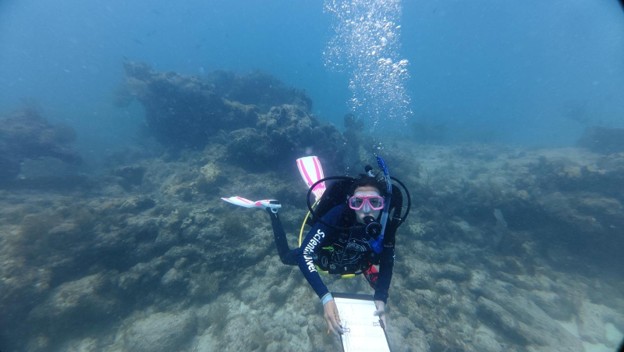
Coco collecting fish population data on Looe Key, Florida
When we arrived in the Keys we set up our clipboards with the data sheets. The data sheets have most of the fish species on them and the letters S, F, M, and A which stand for single (1), few (2-10), many (11-100), and abundant (100+). It’s really hard to count exact numbers of fish underwater, so we use these standardized categories.
The next day we did our first few fish surveys. Every person fills out a survey. We dove from Captain Hook’s boat at Looe Key Reef. When we arrived at the site we filled in the metadata information, such as who is surveying, where the site is, the time, the depth, the conditions, and the reef type.
The sites we went to at Looe Key were spur and groove reef types, which means there were ridges of coral and channels of sand. Some of the most abundant or common fish we saw were Brown Chromis, Sargent Majors, and Yellowtail Snappers. There were some species like the Yellow Tail Snappers and Barracuda that liked to swim above the reef. Others like Gobies, Damselfish and Parrotfish swim in the coral structures. We would swim slowly over and beside the reef recording fish as we dove. There were a lot of hiding spots for fish under ledges.
After the dive we would fill in any remaining metadata, like the time we finished the survey. We headed back to IC2R3 and in the evening we put our data into google sheets.
Each column is a fish species and each row is a survey. We put the data in as numbers instead of letters to help analyze it. So, S=1, F=2, M=3, A=4. After that we made charts comparing the data to 2021 data. We made charts that compared the abundance and diversity for each year at each site and charts that compared both years overall.
Our findings were that our hypothesis was not supported. Diversity and abundance had both doubled. We believe that may be because we had more data from 2025. I really enjoyed learning about how to conduct fish surveys and studying fish, because I’m interested in Marine Biology.
— Coco C., Naut-in-Training, Sarasota Chapter